
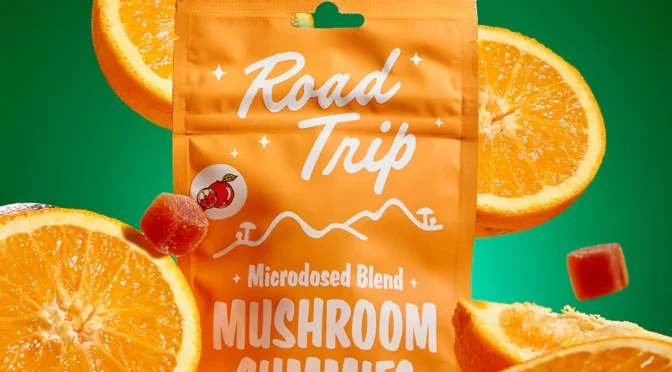
Quick answer: Road Trip Gummies are a widely sold mushroom gummy line marketed as a “legal psychedelic.” Users often report mood lift, mild euphoria, and visual effects. The catch is transparency: the brand markets vague “proprietary blends” and does not publish a clear Supplement Facts panel on some products, so you cannot always verify the active ingredient or dose. If you want a mushroom gummy you can actually verify, a lab-tested, Certificate-of-Analysis-backed option from a transparent shop like deVIN Boston is the safer call. Full breakdown below.
Road Trip Gummies show up everywhere right now. Smoke shops, gas station counters, a hundred affiliate blogs all running the same discount code. So it’s a fair question to ask before you spend money: are they any good, are they safe, and are they actually legal?
I’ve spent a lot of time behind a wellness shop counter walking people through mushroom products, and I’ve watched the “legal psychedelic” gummy category explode. Some of it is solid. A lot of it is hype wrapped in earth-toned packaging. This review cuts through the marketing to tell you what Road Trip Gummies actually are, where they fall short, and what to buy instead if verifiable quality matters to you.
What are Road Trip Gummies?
Road Trip is a brand of mushroom gummies sold as a legal alternative to traditional magic mushrooms. The line spans a few different formulas, and that’s the first thing to understand, because “Road Trip Gummies” is not one product. Reviewers describe at least three categories floating under the brand and similar “road trip style” products:
- Functional / microdose gummies. Built on non-psychoactive mushrooms like lion’s mane, reishi, and cordyceps, aimed at focus and calm with no high.
- Amanita muscaria gummies. Containing muscimol, the active compound in the red-and-white fly agaric mushroom. Not psilocybin, not federally scheduled, but the subject of recent FDA scrutiny as a food ingredient.
- “Proprietary blend” psychedelic gummies. Marketed for euphoria, visuals, and introspection, with the exact active compounds left undisclosed.
That last category is where the real questions begin.
The effects: what users report
On the experience itself, the feedback is mostly positive, which is part of why the brand spread so fast. Across review sites, customers describe the psychedelic-style versions as producing mild to moderate euphoria, light visual distortion, giggly sociability, and a creative, introspective headspace. Reported onset tends to land around 20 to 30 minutes, with effects lasting somewhere in the two-to-six-hour range depending on the formula and dose.
Functional and microdose versions are a different story. Those are taken for daytime focus, steadier mood, and immune support, with no intoxicating effect at all. If your goal is “sharper and calmer during the workday,” that’s the lane you want, and frankly you don’t need a mystery blend to get there.
The problem: transparency and what’s actually inside
Here’s where I have to be honest with you, because most of the reviews ranking for this product won’t be. The effects might be enjoyable, but you often cannot confirm what is producing them.
Independent reviewers have repeatedly flagged that Road Trip does not publish a clear Supplement Facts label on some product pages, which leaves buyers without active ingredient information or dosages. One supplement-analysis publication put it bluntly, calling the missing label a consumer safety issue and advising people not to buy any dietary supplement without access to its facts panel. The brand has described its formulas as containing “legal tryptamines” without specifying which ones.
That vagueness matters more than it sounds. Some tryptamines are perfectly legal. Others are Schedule I controlled substances. At least one detailed independent review concluded the likely active compound in certain Road Trip products is 4-AcO-DMT, a substance the body converts into psilocin, the same active compound found in actual magic mushrooms. Psilocin is a Schedule I controlled substance, and 4-AcO-DMT can be treated as a controlled substance analogue under federal law when sold for human consumption. I cannot verify that claim about a specific batch, and neither can you from the label, which is exactly the point. When a product hides its active ingredient, “is it legal” becomes a question nobody can answer with confidence, including the person taking it.
The mushroom edibles market has a documented mislabeling problem. Testing by researchers and federal regulators has found products containing undisclosed and sometimes illegal ingredients, and the FDA has urged extra caution with products claiming to produce euphoria or psychedelic effects (TIME). A proprietary blend with no facts panel is precisely the kind of product that warning is about.
What about the legal and FDA picture?
Two separate things get tangled here, so let’s untangle them.
First, scheduling. Psilocybin and psilocin are Schedule I and illegal to sell. Amanita muscaria and muscimol are not federally scheduled, which is why Amanita-based gummies can be sold where psilocybin cannot. Functional mushrooms like lion’s mane are simply legal supplements.
Second, the FDA’s food position. In December 2024 the FDA issued a letter stating that Amanita muscaria and its constituents, muscimol, ibotenic acid, and muscarine, are not authorized for use as ingredients in conventional food, and recommended people avoid foods containing them (FDA, 2024). That is a food-additive stance, separate from controlled-substance law, but it tells you the regulatory wind is blowing toward more scrutiny, not less.
The takeaway for a Road Trip buyer: if the product is Amanita-based, it sits in a legally unscheduled but FDA-flagged space. If it’s a “proprietary tryptamine” blend with no disclosure, you genuinely do not know what bucket you’re in. That uncertainty is a reason to be cautious, not adventurous.
Road Trip Gummies: the honest scorecard
| Factor | Assessment |
|---|---|
| Reported experience | Mostly positive; mood lift, mild visuals, social and creative feel |
| Ingredient transparency | Weak; “proprietary blends,” missing facts panel on some products |
| Lab testing / COA access | Inconsistent; not reliably verifiable for every product |
| Legal clarity | Ambiguous; depends on undisclosed actives and your state |
| Availability | Very wide; online, smoke shops, gas stations |
| Best for | Buyers who prioritize convenience over verification |
How to buy mushroom gummies you can actually trust
Whether or not you go with Road Trip, the buying rules are the same. This is the checklist I give people across the counter.
Demand a Certificate of Analysis
A Certificate of Analysis, or COA, is third-party lab proof of what’s in the product, including potency and contaminant screening. This is the single most important step. A trustworthy seller publishes COAs and will hand you one without flinching. If a product can’t show you its lab results, that absence is your answer.
Read the active ingredient and dose
You want the actual compound named (muscimol, specific functional mushrooms) and a milligram dose per piece. “Proprietary blend” with no numbers is a yellow flag at best. You cannot dose responsibly on a secret.
Match the product to your goal
Want daytime focus with no head change? Functional mushroom gummies built on lion’s mane or reishi. Want a relaxed, mildly altered evening? That’s the Amanita lane, with appropriate caution. Naming your goal first keeps you from buying the wrong category.
Mind your medications
If you take serotonin-regulating medications such as SSRIs, SNRIs, MAOIs, or TCAs, mushroom products can interact in ways you don’t want, including blunted effects or worse. Talk to a licensed medical professional before trying anything new.
Buy from someone accountable
A gas station counter has no reputation to protect and nobody who can answer a question. A real shop with a fixed address and trained staff does. That accountability is worth more than a discount code.
A more transparent alternative: lab-tested mushroom gummies at deVINE Boston
If the Road Trip transparency gaps make you uneasy, good, that instinct is correct. The fix is simply to buy from a retailer built around verification instead of mystery.
deVINE, a South Boston wellness shop founded in 2019, takes the opposite approach to the proprietary-blend crowd. Their legal mushroom collection is curated and lab-tested rather than a wall of unverifiable product, and every item carries a third-party Certificate of Analysis you can actually read. You’ll find clearly labeled Amanita-style gummies in defined potencies, functional mushroom gummies for everyday focus, plus tablets and chocolates, all from named formulas rather than secret ones.
The difference is the whole point of this review. With Road Trip you often cannot confirm the active ingredient. At a transparent shop you can read the published lab reports, ask a trained person which product fits your tolerance, and buy from a business that maintains a documented compliance track record. For first-timers especially, that guidance is the thing no proprietary-blend brand can offer.
You can visit deVINE at 619 E Broadway, open 10am to 10pm seven days a week, call ahead at 617-315-7636 to check stock, or browse and order from deVINE online with free shipping over a set threshold. Either way, you’ll know exactly what you’re getting.
Frequently asked questions
Are Road Trip Gummies legal?
It depends on the formula and your state. Functional mushroom versions are legal supplements, and Amanita muscaria versions are not federally scheduled, though the FDA has flagged Amanita constituents as unauthorized food ingredients. The “proprietary blend” versions are the concern: because the active compounds are undisclosed, legality cannot be reliably confirmed. Some tryptamines are federally illegal.
Do Road Trip Gummies actually work?
Most user reviews report real effects, ranging from mild euphoria and mood lift to light visuals in the psychedelic-style versions, and focus or calm in the functional versions. Effects vary widely by person, dose, and which formula you have.
What’s actually in Road Trip Gummies?
That’s the core problem. The brand markets “proprietary blends” and, according to independent reviewers, does not publish a clear Supplement Facts panel on some products. Functional versions list mushrooms like lion’s mane and reishi, but the psychedelic-style versions keep their active compounds undisclosed.
Are Road Trip Gummies safe?
The reported experiences are generally mild, but safety can’t be fully assessed without knowing the active ingredient and dose, which some products don’t disclose. The broader mushroom edibles market has documented mislabeling issues, so the lack of a verifiable COA is a real concern. Consult a doctor before use, especially if you take medication.
Where can I buy mushroom gummies I can verify in Boston?
deVINE Boston at 619 E Broadway in South Boston carries lab-tested mushroom gummies with published Certificates of Analysis, and the staff can guide you on potency and type. It’s a walk-in shop, and they also ship online across Massachusetts.
Are functional mushroom gummies the same as psychedelic ones?
No. Functional gummies (lion’s mane, reishi, cordyceps) support focus and calm with no high. Psychedelic-style gummies rely on compounds like muscimol or undisclosed tryptamines to produce altered effects. Always check which type you’re buying.
The bottom line
Road Trip Gummies are easy to find and many users enjoy them, but the brand’s reluctance to clearly disclose active ingredients and publish lab results is a genuine drawback, not a nitpick. In a category with a real mislabeling problem, “trust us, it’s a proprietary blend” isn’t good enough.
If you want the experience without the guesswork, skip the mystery blends and buy from a shop built on transparency. deVINE Boston’s lab-tested mushroom gummies let you read the COA, ask real questions, and know what you’re putting in your body. That peace of mind is worth far more than any gas station discount code.
Disclaimer: This article is for informational purposes only and is not medical or legal advice. It is an independent review and is not affiliated with or endorsed by Road Trip Gummies. Products discussed have not been evaluated by the FDA and are not intended to diagnose, treat, cure, or prevent any disease. You must be 21 or older to purchase these products. Mushroom products may cause drowsiness; do not use while driving or operating machinery. Consult a licensed medical professional before use, especially if you are pregnant, nursing, taking medication, or have a medical condition. Laws regarding mushroom products vary by jurisdiction and change frequently; verify current local regulations before purchasing.